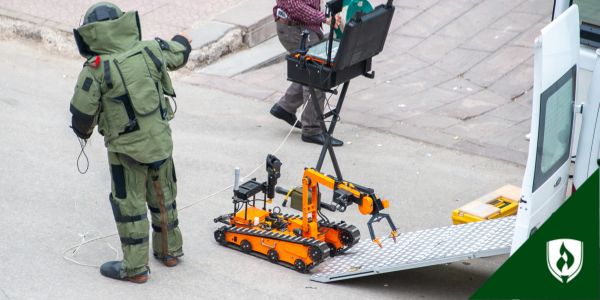
What is Law Enforcement?
05/05/2026

Rasmussen University’s Law Enforcement associate degree program meets the educational standards established by the Minnesota Peace Officer Standards and Training Board (POST) for persons who intend to seek employment in Minnesota as a peace officer. This program does not meet the standards of states other than Minnesota. This program is only open to residents of Minnesota, or those willing to sign an attestation of their interest to seek employment in Minnesota as a peace officer.
When people think of law enforcement, they often picture officers responding to emergencies or high-profile incidents. In reality, law enforcement encompasses a wide range of tasks and responsibilities, and it operates within the larger justice system.1
According to the 2018 data from the Census of State and Local Law Enforcement Agencies (CSLLEA), there were an estimated 17,541 state and local agencies performing law enforcement functions, including municipal police departments, county sheriff’s offices, and state police agencies. This number does not include federal law enforcement agencies, which operate under separate federal departments. These are discussed later. Understanding the scope of law enforcement at these different levels can help clarify how agencies operate and interact with communities.1,2
Law Enforcement Within the U.S. Justice System
Law enforcement is typically the first stage in the justice system, serving as the initial point of contact when a potential crime is reported or discovered. Officers investigate incidents, collect evidence, and identify possible suspects, allowing cases to move forward to prosecutors and the courts.3
Law enforcement interacts with other components of the system, such as courts, corrections, and regulatory agencies. Its role is primarily to gather information, maintain public order, and support the enforcement of laws, forming one part of the broader, multi-level process designed to address legal violations.3
Common Responsibilities of Law Enforcement Officers
Law enforcement personnel, including police officers, detectives, and criminal investigators, generally perform a variety of duties, which may include:4
- Responding to emergency and nonemergency calls
- Patrolling assigned areas to observe people and activities
- Conducting traffic stops and issuing citations
- Searching restricted-access databases for vehicle records, warrants, or other information
- Obtaining and serving warrants for arrests, searches, or other purposes
- Arresting individuals suspected of committing crimes
- Collecting and securing evidence from crime scenes
- Observing the activities of suspects and maintaining records
- Writing detailed reports and filling out required forms
- Preparing cases for legal proceedings and providing testimony in court
Job duties may vary depending on the type of agency, the jurisdiction, or the officer’s specific role. Officers are typically required to document activities and maintain accurate records in accordance with agency policies and applicable laws. Many officers carry standard law enforcement equipment such as radios, handcuffs, and firearms.4
Some law enforcement roles focus on specific areas:4
- Detectives and criminal investigators may specialize in investigating serious crimes, conducting interviews, examining records, monitoring suspects, and participating in arrests or raids. In large departments, they may focus on one type of crime, such as homicide or fraud.
- Federal agents, such as those with the FBI, investigate cases that involve federal law or cross state lines and may join or take over certain state investigations.
- Fish and game wardens enforce laws related to fishing, hunting, and boating, conduct search and rescue operations, investigate complaints, and educate the public.
- Patrol officers in police departments or sheriff’s offices typically carry out general law enforcement duties, perform regular patrols, and respond to calls. Some may eventually serve in specialized units, including SWAT, motorcycle units, or mounted divisions.
- Transit and railroad police focus on transportation hubs, protecting property, employees, and passengers, removing trespassers, and checking identification in secure areas.
These responsibilities illustrate the range of tasks law enforcement personnel may engage in, depending on their agency, role, or area of focus.4
Additional education, specific work experience, and/or specialized training may be required to work in specialized areas of law enforcement. It is important to check the requirements needed to work for the various agencies.
Types of Law Enforcement Agencies
Law enforcement in the United States operates at multiple levels, each with distinct responsibilities and jurisdictions.
- Local Agencies: Local police departments and sheriff’s offices enforce laws within cities, towns, or counties. Police chiefs are typically appointed by municipal authorities, while sheriffs are often elected by county residents. Local agencies may respond to incidents, conduct patrols, and monitor community activity to maintain public safety.5,6
- State Agencies: State police or highway patrol operate across an entire state and may provide support to local agencies, particularly in traffic enforcement or statewide investigations.6
- Federal Agencies: Many federal law enforcement agencies are organized under the U.S. Department of Justice (DOJ), while others are organized under different federal departments. Key offices include the Federal Bureau of Investigation (FBI), Drug Enforcement Administration (DEA), Bureau of Alcohol, Tobacco, Firearms and Explosives (ATF), and the U.S. Marshals Service, which investigate federal crimes and enforce national laws. Other DOJ offices, such as the Bureau of Prisons, Office of Justice Programs, and Bureau of Justice Statistics, provide research, operational support, and data to assist law enforcement efforts.7
This structure illustrates how law enforcement functions are divided across local, state, and federal levels, highlighting the range of agencies involved in enforcing laws and supporting the justice system.7
How Law Enforcement Agencies Are Structured
Law enforcement agencies in the United States differ in structure, leadership, and staffing, with variations that depend on jurisdiction, community size, and agency type.5
Police chiefs are typically appointed, while sheriffs are usually elected. Local police departments and sheriffs’ offices vary in size, with smaller communities having fewer officers per resident and large cities having more. For example, departments serving populations over 1 million may have roughly 3 officers per 1,000 residents, while smaller towns may have 1-2 per 1,000.5
About 14% of sworn officers are female, though leadership roles see fewer women in top positions.5
Key Skills for Law Enforcement Officers
Law enforcement personnel, including police officers, detectives, and fish and game wardens, may rely on a range of skills and qualities in carrying out their duties:8
- Communication skills: Clear communication, both written and verbal
- Empathy: Understanding the perspectives of other
- Good judgment: Determining the best way to respond to a variety of situations
- Leadership skills: Being comfortable in highly visible roles
- Perceptiveness: Anticipating people’s reactions and understanding their behavior
- Physical strength and stamina: Maintaining fitness to meet entry requirements and daily duties
These skills are commonly emphasized in law enforcement training and professional expectations and may support officers in fulfilling their responsibilities effectively.8
Understanding the Role of Law Enforcement
If you’re interested in learning more about law enforcement, exploring the different types of agencies, how they operate, and the roles officers play can provide valuable insight into the justice system.
Looking into official reports, agency guides, or educational resources can help you see how law enforcement fits into broader public safety efforts and how its work interacts with courts, corrections, and communities.
1Bureau of Justice Statistics, “Law Enforcement,” available at https://bjs.ojp.gov/topics/law-enforcement (accessed April 7, 2026).
2Bureau of Justice Statistics, Census of State and Local Law Enforcement Agencies, 2018 – Statistical Tables, available at https://bjs.ojp.gov/library/publications/census-state-and-local-law-enforcement-agencies-2018-statistical-tables (accessed April 7, 2026). Employment conditions in your area may vary.
3Bureau of Justice Statistics, “Justice System,” available at https://bjs.ojp.gov/justice-system (accessed April 7, 2026).
4Bureau of Labor Statistics, U.S. Department of Labor, Occupational Outlook Handbook, Police and Detectives, at https://www.bls.gov/ooh/protective-service/police-and-detectives.htm#tab-2 (accessed April 7, 2026). Employment conditions in your area may vary.
5Bureau of Justice Statistics, “Agency Characteristics of Law Enforcement,” available at https://bjs.ojp.gov/topics/law-enforcement/agency-characteristics (accessed April 7, 2026).
6U.S. Department of Justice, Policing 101: A Primer on Modern Policing Practices, available at https://www.justice.gov/d9/policing_101_content.pdf (accessed April 7, 2026).
7U.S. Department of Justice, “Organizational Chart of the Department of Justice,” available at https://www.justice.gov/agencies/chart/map (accessed April 7, 2026).
8Bureau of Labor Statistics, U.S. Department of Labor, Occupational Outlook Handbook, Police and Detectives, at https://www.bls.gov/ooh/protective-service/police-and-detectives.htm#tab-4 (accessed April 7, 2026). Employment conditions in your area may vary.