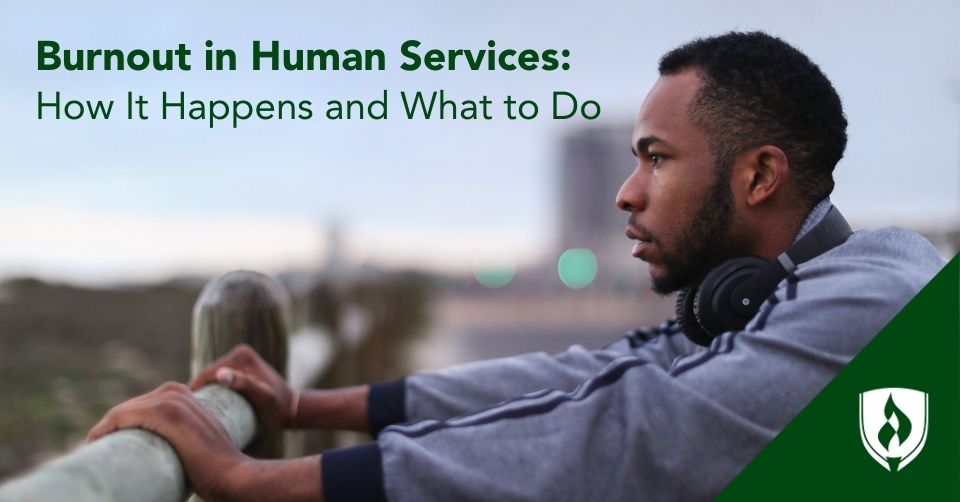
For me, burnout came on slowly.
It can happen so slowly, that you don't really notice until one day, you realize that you are feeling dread about every new client or meeting. You don't enjoy what you are doing, you're buried in paperwork. Everything all starts to pile on, and suddenly, you don't have any positive feelings about your work or any joy in what you do.
But the confusing thing is that it can also present in the opposite way. Burnout can also look like we are doing great at work but are not functioning at home.
Are you a person after work—available to your loved ones and family?
Or are you coming home a zombie?
Do you have any energy and joy for things outside of work? Are you engaging in social activities? Avoiding our people is a sign we are putting to much into work and not enough into our selves.
To understand the increased risk of burnout in this field—and what to do about it, read on. Avoiding burnout in human services will take more than a nice candle and hot bath, but it's absolutely doable.
Rasmussen University’s Human Services Associate’s degree and Human Services Bachelor’s degree programs are not designed to meet, and do not meet, the educational requirements for professional licensure as a therapist, counselor, social worker, psychologist, or other similar licensed careers, in any state.
Factors that contribute to social services burnout
Social services seem to have higher rates of burnout than most other fields. The Maslach Burnout Inventory (MBI) is a common survey tool in the industry, used to evaluate the mental well being of professionals in social services.1
In one UK study in 2024, the MBI found that "73% of the respondents had elevated levels of emotional exhaustion. 26% reported high levels of depersonalization, which could cause social workers to become hardened towards the provision of services." Interestingly, the survey evaluators also found "remarkably elevated levels of personal accomplishment (91%)" where respondents also felt good about the work they were doing in the world.2
That combination of exhaustion and rewarding satisfaction could well be a hallmark of this industry.
Burnout in human services (plus health work, social services and more) happens for a combination of reasons—some obvious and others less so. If you are working in social services, human services or healthcare roles (or if you are planning to), take a look at how things can stack up.
1. We work with people in crisis
We work daily with clients who are living through some of the worst days of their lives. By the time patients come to us, many other systems have failed them. Some of them have hit their own rock bottom, and the sense of hopelessness can be overwhelming.
This is especially strong in fields like child welfare, mental health and substance abuse. Social worker burnout gets discussed a fair bit, but the issue of burnout can be just as prevalent in healthcare workers, mental health staff, social work assistants, administrative workers in human services and, really, anyone in this field.
2. We often have long hours and heavy workloads
The systems of social services aren't sufficient to meet societal needs right now. So the supply of patients is often greater than the services and professionals available to help them. Resources can feel thin.
The workplace symptoms that can cause burn out include...
- Long hours
- Excessive workloads
- Administrative burdens
- Patient care documentation
- Chronic stress
Administrative burdens and being short-staffed can stretch workers and become overwhelming. Changes to staffing or actions may offer some relief, but without system changes, the burnout cycle will continue. Job dissatisfaction is one of the biggest reasons individuals leave the field of human services.
3. We can experience compassion fatigue
Frontline workers are exposed to psychological stress, reading and hearing stories from clients focused on harm, abuse and neglect. Eventually this takes a toll on physical health and mental health.
An example of this would be...maybe you got into human services because you wanted to be there for people in their darkest moments, but suddenly when you start to hear a client disclose trauma and indicate that they are ready to work on the trauma, you feel a sense of dread--at the thought of guiding that therapeutic work and spending time on it even further.
This is a solid indicator because clients who are ready to do that work can be rare. When the client is ready but the professional is not—this is a sign of compassion fatigue.
Another example is when you start to see or hear trauma in everything around you. You are always ready to respond, you are always in crisis mode. This drains your body and depletes empathy. Compassion fatigue clouds your response to a situation with feelings of ugh, instead of feeling like you can help.
Compassion fatigue can lead to physical symptoms, as well as a high risk of developing mental health and substance use issues.
4. We can experience vicarious secondary trauma
When we learn about traumatic things that happened to our clients, we can experience a little of that horror, just by listening to them describe it. Those sips of trauma can add up and can start to color our worldview. When you witness so much suffering, you suffer too.
There was one time I was working as a therapist, supporting children in the child welfare system. And I did get overloaded with all the trauma in my cases, paperwork demands, and lack of team support.
There was a day I remember where I just could not function, I could not stop crying. I felt tired, physically and emotionally. I took a day off, worked to reset and was very intentional about setting boundaries to better manage my cases, paperwork, and other duties to prevent it from getting worse.
For more on that, check out Vicarious Trauma vs. Secondary Trauma: A Guide for Professionals at Risk.
Burnout is bad for you and for your clients/colleagues
In human services, our jobs tend to mean a lot to us. We believe in what we do; we see the impact we make on people's lives.
Sometimes, it can feel like taking a step back will mean letting our clients, colleagues and patients down. Sometimes, if our workplace is under-resourced, that might even be true.
If you take the breaks you need, or set boundaries, something might go undone. But here's the thing—if you let burnout continue, you will cause more pain or drop more balls as time goes on. Your dysregulation will start to impact everything you do. It's so much better to take burnout seriously and address your health right away—before things get worse.
When I saw people struggling with burnout, it was clear that their ability to care was just gone. Their paperwork piled up or was poorly completed. They would be late, miss meetings, deadlines and other commitments. Their attitude would be poor, and they were often unpleasant. They might be snippy or look lazy.
These people might have once cared so much about their work that they wouldn't take vacation, and now, they let people down and things slip through the cracks continually.
It doesn't have to be like this
Burnout in human services can sound like a lot of doom and gloom, followed by a "and it's up to YOU to fix it—just like you have to fix everything else."
The larger systems at play should make this easier on us. Human services should be a higher priority, be better funded, better organized and supported in more preventative ways so we can help people before everything in their lives has crashed and burned. There are people, roles and organizations advocating for just that.
Meanwhile, though, human services professionals do need to make their jobs sustainable.
I had a coworker who was amazing at handling stress, burnout and fatigue. She was a positive light in the office and worked hard to make a community among staff. She was always a source of support.
She worked very hard but had boundaries about taking work home (both emotionally and literally). She took time off regularly to recharge, regroup, or just relax. She also started her day with a workout and was intentional about her diet, prioritizing health.
Ways to make your work in human services sustainable
Compassion fatigue, vicarious trauma, and secondary traumatic stress all refer to the same feelings of emotional exhaustion, overwhelm, and over-use of empathy that a comes in working in the human services system.
If you know what burnout looks like and resolve to take it seriously, you are already doing something to combat burnout. In social services, we often hear about self-care and the importance of this. Self-care simply means taking action to preserve health and mental health. It is not something that can fix a problem, however; it needs to be proactive and preventative.
Here are some things you can do.
1. Define self-care for you
Self-care is not all bubble baths and massages. Real self-care is what works for the individual. Sometimes this is about connecting to what you love. If you love watching comedy TV while crocheting, then that is part of your self care. If you love animals, then spending time with a pet or getting out into nature should be part of your self care.
If you love to nurture your creative side, making time for a pottery class or bringing your paints to a park might be your self-care.
It doesn't have to look like someone else's routine.
2. Don't neglect your physical health
Health for your body is an essential part of self care. Afterall, caring for all of yourself will include body and mind. That will mean eating nutritious meals and getting exercise, along with establishing and maintaining boundaries.
If you are skipping lunch and running on caffeine, then crashing at home with a bag of chips, you probably are not getting the nutrients you need. If you spend all day in your office, then collapse on the couch at home, you probably aren't getting the fresh air and movement you need.
Structure some time into your daily habits to meet your physical needs, and you will be more resilient against burnout.
3. Set and maintain boundaries
You may have already noticed that the bottom line solution to both of the above recommendations is "make time."
That tends to be the hardest part. Often, in human services, the only way to make time is to set and protect your boundaries.
Things to mitigate burnout and compassion fatigue center on boundaries. Finding ways to control your schedule or being intentional about planning time for paperwork can be critical.
Knowing when you work best can also help. Human service schedules may not align with 9-5 hours but figuring out what works for you can help. Is it possible to schedule home visits one day and paperwork another? Do you block morning time before appointments for paperwork or at the end of your day for paperwork?
You don't have to do this alone. Supervisors can implement strategies that support self-care and stress reduction by fostering a community among coworkers that helps uplift principles of self-care and reduce stress. It can be hard to be proactive when our jobs make us feel two steps behind. But getting out in front of burnout is better for everyone in your workplace.
4. Take time off, routinely
I struggled most in my roles when I was not using my vacation.
There were points in my career where I could not earn more PTO days, so I had to take a day each pay period. These bi-weekly, 3 day weekends were beneficial in getting a break. Blocking time more intentionally might have been more effective in preventing burnout.
Taking time does not need to be an elaborate vacation, it just needs to be time away from work that provides a positive response and decreases feelings of stress. That won't happen if you bring your work with you. Time off should be time truly away. Make yourself as unreachable as possible. This is one of those boundaries to protect.
5. Let your loved ones help
Who helps the helpers?
Maybe it’s the people who love them dearly.
Personal relationships like family, friends and communities are critical in combating compassion fatigue by offering support and staying connected to a world outside of work. We don't all have the same safety nets or support networks, but if you are lucky enough to be near people who love you, let them care for you.
6. Arrange your own mental health support
Lots of people come to social services because they've been through something themselves—and they know how unbelievably hard things can be. This gives us huge stores of compassion, but our own issues can still stay with us.
Even if you haven't needed mental health support up to this point, consider arranging something like therapy, counseling or other forms of treatment for yourself. Even if you don't begin that now, just knowing who to call if things get bad takes a huge barrier out of your path.
Access to quality, confidential mental health is vital to supporting cases of secondary traumatic stress.
Look forward to your future in human services
It is critical to workforce retention that individuals and organizations focus on strategies to promote well being and mitigate burnout. This has become a major public health challenge as we continue to see fewer resources and more needs.
While there is never an assurance that a job will be gentler or calmer, it can be possible to find less stressful roles.
When I transitioned from being a therapist to a trainer, this role brought less direct, day-to-day contact with stress and trauma. I worked to build resources and find ways to help alleviate the stress for workers. I was able to be a support in the office.
I also worked in prevention roles, doing education with junior high and high school students. We would present curriculum and try to gather stakeholders to promote our prevention goals. While there were busy times that had stress, we were working to build community, proactively. That gave me a break from the intensive work of healing.
Burnout is not unsolvable or inevitable. There are things you can do. For the sake of your clients and yourself and your loved ones—be preventative. Doing so, you can also protect the love, compassion and joy that draws you to this kind of work.
Human services isn’t the right field for everyone. But if it might be right for you, check out What Can You Do With a Human Services Degree.
1Burnout Self-Test, Maslach Burnout Inventory (MBI), May 2020, https://different.hr/wp-content/uploads/2020/05/Maslach-Burnout-Inventory-MBI.pdf
2Ratcliff M. Social Workers, Burnout, and Self-Care: A Public Health Issue. Dela J Public Health. 2024 Mar 29, https://pmc.ncbi.nlm.nih.gov/articles/PMC10987033/#sec5