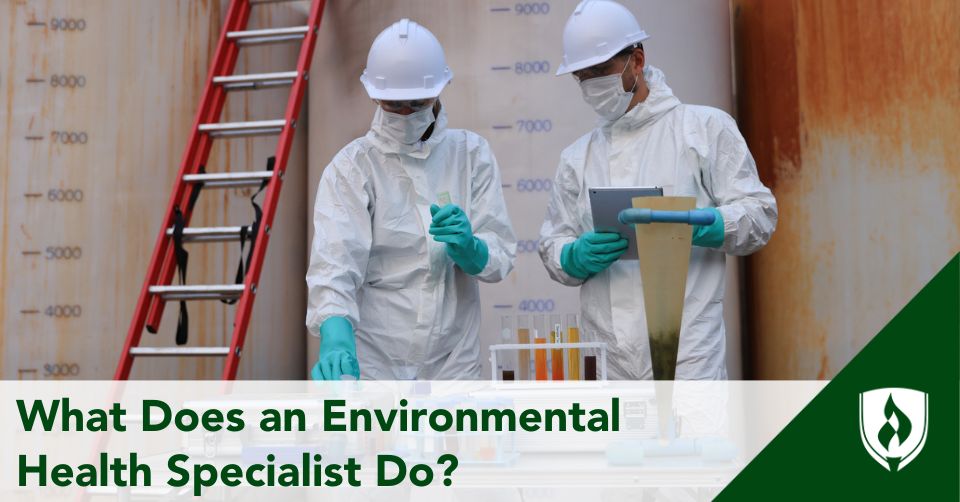
Have you ever wondered who keeps our food supply and water safe? Who keeps an eye on air pollution levels or local hazards like the toxicity of ground water?
“An environmental health specialist is a public health role, and a big focus of public health is prevention,” says Rikkisha Gilmore-Byrd, Dean of Health Science at Rasmussen University.
“One of the reasons for that is the healthcare economy,” she says. “If we can support people in their health and wellness before they get sick, there will be less strain on our healthcare systems, less cost and a better ability to focus our resources—not to mention, the higher quality of life and better outcomes for patients.”
Environmental health specialists work behind the scenes to do just that. They protect what and where we eat, breathe, sleep, work and play. Students interested in issues such as sustainability and human health may be curious about what environmental health specialists do.1
Understanding public health hazards
24% of all estimated global deaths each year are because of environmental factors, according to the World Health Organization.2
The high percentage of deaths occurring each year from environmental factors is also connected to climate change, which worsens dangerous qualities like air pollution, vector-borne disease, heat, storms and flooding.
For example, there was a 6% rate of increase in death related to heat or cold exposure, worldwide, between 2013 and 2023, according to The Global Burden of Disease, Injuries, and Risk Factor (GBD) study.3
Today's environment is rife with hazards, from disease outbreaks to air pollution and myriad environmental health issues arising from those hazards. Pandemics, rampant wildfires, storm water runoff, poor sanitation, toxic waste, chemical exposure and more can cause untold harm to people and animals.
Environmental health professionals are needed to safeguard human health by keeping natural resources free of contaminants—and ensuring that individuals and businesses meet with environmental laws.
But education is part of the environmental health specialist role as well.
“You could develop programs that are going to help people understand things like the long-term effects of living in an area with a high percentage of toxins in the air, and how to address this,” Gilmore-Byrd explains.
Roles and responsibilities in environmental health
The field of environmental health is quite varied. People in these careers may be responsible for:
- Educating communities about environmental issues
- Investigating contamination incidents
- Collecting data such as water samples from public water supplies
- Overseeing wastewater disposal system design and well water systems
- Supporting the development of new environmental laws
- Assessing food handling and compliance
- Supporting physicians and other medical personnel in understanding sources of disease
- Monitoring sources of wastewater contamination such as construction and manufacturing sites
- Understanding the source of disease outbreaks
- Reporting data to organizations for environmental science
How environmental health specialist ensure compliance
Enforcing local, state and federal environmental regulations and laws is a large part of the role.
Depending on their area of specialization, an environmental health specialist may inspect restaurants, apartment buildings, nursing homes, hospitals, public pools or other locations. Based on the type of establishment, inspectors look at many factors such as handling and storage of food, temperature controls, cleanliness of equipment, pest control and documentation.
In some states like California, environmental health professionals work to ensure housing is safe from harmful conditions such as lead paint and overcrowding. Others may monitor disposal of waste at landfills, wastewater disposal systems, recycling centers, and similar facilities.5
An inspector’s job isn't to "catch someone out" during health and safety audits, but to help businesses and other organizations understand how to foster public health. To that end, environmental health specialists study occupational health hazards, stay up-to-date on changing environmental regulations, and communicate about safety regulations and other protocols.
How environmental health specialists shape environmental policies
As the go-to source for assessing environmental factors, environmental health specialists must have deep knowledge of existing environmental regulations. They also can consult with governments and others considering the development of new policies. The right policies / laws can help to protect the public by ensuring we have access to clean drinking water, air and food supplies.
Environmental policies may come from a government agency or from an organization looking to improve self-governance. For example, some businesses may also hire environmental consultants to provide industrial hygiene. This work involves evaluating and resolving potential workplace hazards like chemical spills.
Career opportunities for environmental health specialists
Professionals in environmental health often have a combination of office and field work. They are typically employed at:
- Federal, state and local agencies
- Construction and manufacturing sites
- Hospitals and other healthcare facilities
- Military bases
- Colleges and universities
- Consulting firms
Urban vs. rural priorities in environmental health
These roles may vary quite a bit based on our location, as hazardous material sources will be different in urban vs. rural settings. For example, environmental problems in rural areas may result from fertilizers and runoff from factory farms while cities will experience health hazards from transit systems, development and industrial sites.
Your location may also dictate other public health priorities.
For example, environmental health disparities and disease patterns are vastly different in cities vs. less populated areas.4 Public health officials in crowded areas may content with high childhood asthma rates due to source pollution while rural communities may face increased concerns about sewage due to the prevalence of private septic systems.
Pros and cons of working as an environmental health specialist
There are many advantages and some disadvantages to working in public health, depending on your workstyle preferences and your skill sets.
Pro: Creating a cleaner environment serves the public good. You're helping to champion your community.
Con: Health inspectors may face exposure to toxins or unsanitary conditions. You may see unpleasant things related to health code violations.
Pro: Environmental health specialists need strong interpersonal skills since they regularly deal with the public. If you're a people person, you may enjoy this aspect of the job.
Con: Since enforcement is a large part of the job, you may encounter people who are resistant to regulations or inspections. Dealing with these situations diplomatically is an acquired skill.
Pro: Environmental health is far from dull. This is a dynamic field where you're continually learning.
Con: Being an environmental health specialist requires attention to detail. Understanding complex regulations and writing reports are essential parts of the job. Being thorough and conscientious goes a long way.
Essential hard and soft skills in environmental health
Aspiring environmental health specialists need a range of skills to succeed in this career. For example:
- Written and oral communication for interacting with the public and producing technical reports for your employer/agency
- Scientific background to help with understanding and interpreting environmental regulations
- Investigative skills for addressing incidents and identifying pollution sources
- Data analysis for collecting and analyzing environmental samples
- Risk management to help individuals and organizations reduce public health risks
- CPR / first aid in roles where you'll be responding to emergency situations
How to get involved in environmental health
If you're interested in pursuing a career as an environmental health specialist, check out How to Become an Environmental Health Specialist to see what it takes.
1What Is an Environmental Health Specialist? (Plus Skills), Indeed.com, November 20, 2025, https://ca.indeed.com/career-advice/finding-a-job/what-is-environmental-health-specialist
2SDG Target 3.9 Reduce the number of deaths and illnesses from hazardous chemicals and air, water and soil pollution and contamination, The Global Health Observatory, World Health Organization, https://www.who.int/data/gho/data/themes/topics/sdg-target-3_9-mortality-from-environmental-pollution
3Key findings from GBD 2023, Global Burden of Disease (GBD), IHME, https://www.healthdata.org/research-analysis/gbd-key-findings
4Wu CYH, Evans MB, Wolff PE, Gohlke JM. Environmental Health Priorities of Residents and Environmental Health Professionals: Implications for Improving Environmental Health Services in Rural Versus Urban Communities. J Environ Health. 2017 Dec, National Library of Medicine, https://pmc.ncbi.nlm.nih.gov/articles/PMC6880953/
5Careers in environmental health, California Conference of Directors of Environmental Health, 2026, https://www.ccdeh.com/careers