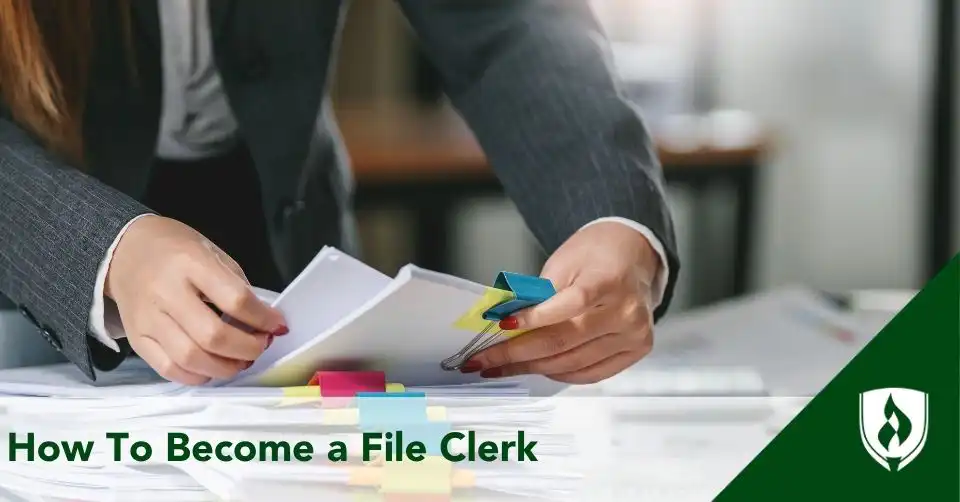
How To Become a File Clerk
10/29/2026
The Accounting Certificate, Accounting Associate’s degree, and Accounting Bachelor’s degree programs at Rasmussen University part of American Public University System (“Rasmussen University”) do not meet the educational requirements for licensure as a Certified Public Accountant (CPA) in any state.
A file clerk helps organizations keep paper and electronic records organized, accessible and up to date. The role is part of the broader information clerk occupational group. According to the U.S. Bureau of Labor Statistics (BLS), information clerks typically need a high school diploma and learn their skills through short-term on-the-job training.1,2
If you're considering a file clerk career, you may be wondering what education or training is involved, what the work entails and which skills are commonly used in the role. Below, we'll walk through the typical path toward becoming a file clerk.
A Typical Path Toward Becoming a File Clerk
While there's no single required sequence, many people pursuing this role follow a similar general process, combining basic education with the skills and training the job tends to call for. Requirements can vary by employer and specific position.
Step 1: Earn a high school diploma or equivalent. For many aspiring file clerks, the first step is completing high school or earning an equivalent credential. According to the BLS, information clerks, including file clerks, typically need a high school diploma.1 Education requirements can vary by employer and position.
Step 2: Develop computer and office skills. According to the BLS, file clerks need to be comfortable working with electronic records and using common computer applications, since much of the role's data entry and retrieval work happens digitally.2
Step 3: Build organizational and communication skills. Organization is an important part of file clerk work. Information clerks need to retrieve files and other important information efficiently.1 Communication skills may also be used when working with coworkers, customers or members of the public.1
Step 4: Complete on-the-job training. Most information clerks receive short-term on-the-job training, usually lasting a few weeks.1 Training typically covers clerical procedures and the use of computer applications.1 Employees may also learn an organization's specific filing systems, records procedures, software and office processes.
What Does a File Clerk Do?
File clerks maintain electronic or paper records for organizations. According to the BLS, their duties may include entering and retrieving data, organizing records and filing documents. In workplaces that use electronic filing systems, file clerks may also scan and upload documents.2
Information clerks, a broader role, may include maintaining records, collecting data and providing information. They may use computers, telephones, scanners, shredders and other office equipment as part of their work.1,2
Skills a File Clerk Needs
- Organizational skills, for maintaining records and retrieving files and other important information efficiently.1
- Computer skills, for working with electronic records, entering and retrieving data, and using computer applications.1,2
- Attention to detail, for accurately organizing, entering and maintaining records.
- Communication skills, for communicating information clearly and interacting with coworkers, customers and others.1
Where Can File Clerk Experience Lead?
File clerk experience can be followed by other administrative positions, depending on an individual's education, experience and the requirements of a particular employer. The BLS notes that some information clerks advance to administrative positions with more responsibilities, such as secretary and administrative assistant roles.1
Exploring the Accounting Associate's Degree at Rasmussen University
A college degree is not typically required to become a file clerk. However, because the role often involves many of the same foundational skills as accounting work, such as careful recordkeeping, data entry, and computer applications, some people use that experience as a starting point for further education in a related field like accounting.
The online Accounting Associate's degree at Rasmussen University includes coursework in accounting foundations, computer applications, Excel®, communication and problem-solving. Students use applications such as QuickBooks® and Excel and learn about maintaining account records, inputting and processing information, and producing standard accounting reports.3
The curriculum includes courses such as Financial Accounting I, Payroll Accounting and Financial Investigation.2 The program can be completed online and uses a laddering approach in which students can earn an Accounting Certificate while completing the Associate of Applied Science degree. Credits may also be transferred toward Rasmussen University's online Accounting Bachelor's degree, subject to applicable transfer policies and requirements.3
If you're exploring education related to business, accounting and computer applications, the online Accounting Associate's degree at Rasmussen University is one program to consider.3
Earning a degree does not guarantee employment or specific job outcomes. Employment conditions in your area may vary. Requirements for individual positions vary by employer.
QuickBooks® is a registered trademark of Intuit Inc., 2632 Marine Way, Mountain View, CA 94043.
Excel® is a registered trademark of Microsoft Corporation, One Microsoft Way, Redmond, WA 98052-6399.
1Bureau of Labor Statistics, U.S. Department of Labor, Occupational Outlook Handbook, Information Clerks, at https://www.bls.gov/ooh/office-and-administrative-support/information-clerks.htm#tab-4 (accessed Sept. 3, 2026). Employment conditions in your area may vary.
2Bureau of Labor Statistics, U.S. Department of Labor, Occupational Outlook Handbook, Information Clerks, at https://www.bls.gov/ooh/office-and-administrative-support/information-clerks.htm#tab-2 (accessed Sept. 3, 2026). Employment conditions in your area may vary.
3Rasmussen University, Accounting Associate's Degree, at https://www.rasmussen.edu/degrees/business/accounting/associates/ (accessed Sept. 3, 2026).